
Jenna McCray’s first drink in Scotland. When the New Yorker find herself in the coastal village of Anand is a pint of Scottish-brewed heather ale, …
Jenna McCray’s Taste of Scotland
Jenna McCray’s first drink in Scotland. When the New Yorker find herself in the coastal village of Anand is a pint of Scottish-brewed heather ale, …
Jenna McCray’s Taste of Scotland

Delevan House: Part 1 We’ve enjoyed sharing ‘The Making of Delevan House’ with you in a series of posts on Brazen Folk Horror before our release on …
The Cast of Delevan House #1

It fills me with terror when I see short turnaround periods offered for manuscripts on some freelance service platforms, where folk offering many different services can utilise to garner business. Often a guaranteed timeline is presented upfront without assessing the writing requiring the work. Is it arrogance or ignorance of editing skills involved?
Editing speeds vary from person to person. Yes! this is a set of skills that requires the human brain, not AI, not an app!
Multiple factors feed into how long a project will take, such as the type of editing, word count, language(s) used and the overall condition of the manuscript. Another critical factor is the editor’s familiarity with the writer’s work. The more familiar, the more we know the nuances and common errors that arise and the slicker one can become in completing a manuscript.
When I see small house publishers or independent writers churning out book after book, I wonder how much time is spent on this essential process and how many passes a book undergoes before publication. I also wonder ‘who’ is editing. It’s a dangerous assumption that any writer or reviewer can also be an effective editor. Editing is far more than reading and spotting the odd typo. Unfortunately, the latter is a common ignorance in particular writing circles and some so-called ‘editors’.
As a serious writer with pride in your work, you should consider these questions too. Consider what an editor and publisher can genuinely do to add value to your process before signing a contract.
From my desk (and I’ve already explained how many factors play in), I average 1k-2k words per hour. I reiterate this is editing, not reading.
As a simple example, a 60k manuscript = 60 hours of work. What would you expect to be paid for working 60 hours?
This little example is worth considering when you are pricing an editor — who will have additional tasks before the edit begins on your piece. The essential set-up stages also cost them time. And as the saying goes, in business, time is money.
When I set up my editing business, Word Refinery, I offered introductory rates. As a passionate freelancer and supporter of creatives, I supported small publishing houses with additional discounts at my own expense. Independent businesses incur more costs than just time — which is one of the most valuable commodities. And, of course, the cost of everything is rising worldwide. With that, Word Refinery fees are under review.
Professional relationships between writer and editor or publisher and editor require a two-way level of respect. Fees are an integral component of that.


Delevan House is a dark fantasy horror that leans heavily on folk tales, mysticism, and lore. The village of Badb is a place with many secrets …
Delevan House by Ruthann Jagge and Natasha Sinclair

Order Delevan House here.
The Making of Delevan House #22

They say you always remember your first. We are eternally grateful to all our exclusive first readers, and absolutely blown away by the depth of our…
First Blood: Delevan House Review

Access the playlist Ruthann and Natasha created the first Brazen Folk Horror novel to on Amazon Music or Spotify. Just click! Order Delevan House …
The Making of Delevan House #21

Order Delevan House here.
The Making of Delevan House #20
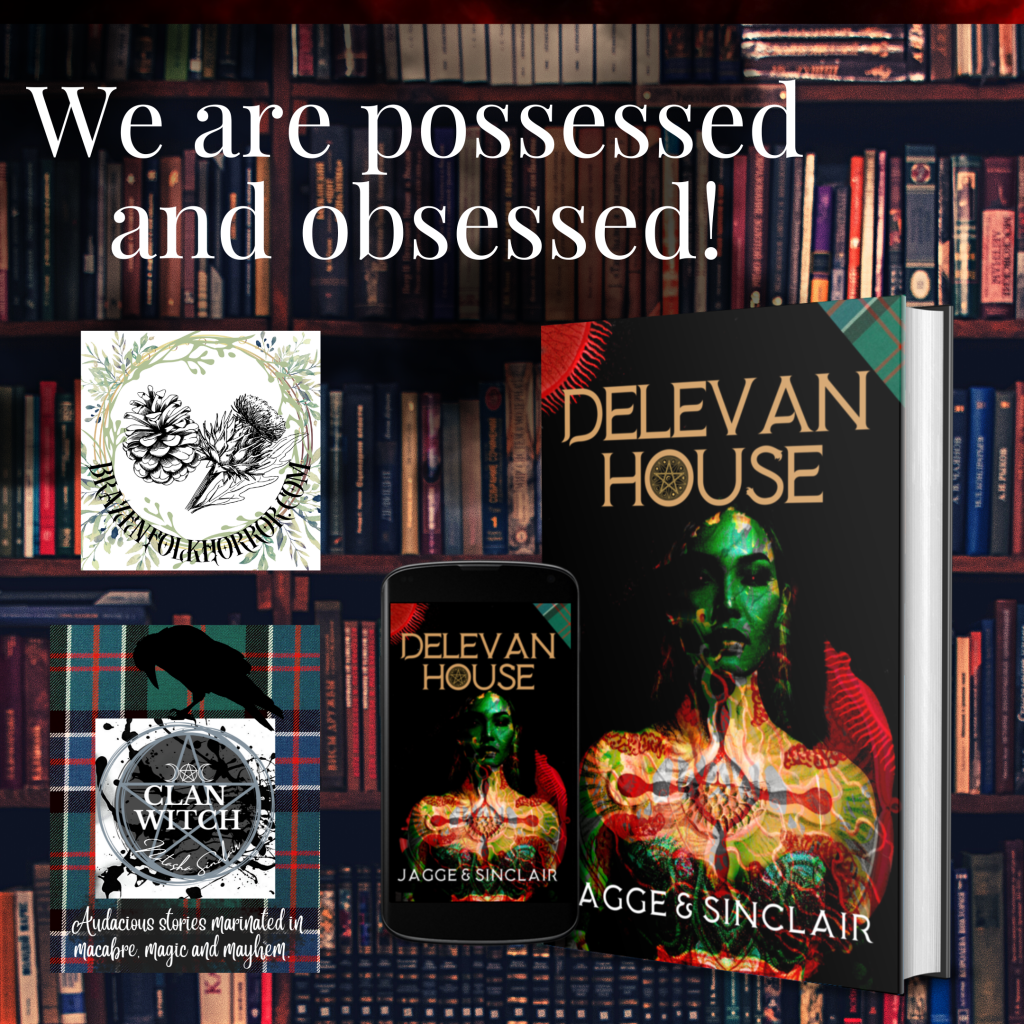
I have been immersed in creativity while juggling the craziness of everyday life and spanners. Over on Brazen Folk Horror, Ruthann Jagge and I have been actively sharing updates with readers weekly for five months now. With only three pre-release updates left to go, our novel launch is imminent!
My adrenaline is at full whack. We have joked about being possessed by our characters, but it’s most definitely an obsession at play too.
For readers who may not yet have picked up a title from either of us and you’d like a sample, then a great place to start before our collaborative novel lands is our debut novellas released just last year.
The New Girls’ Patient, Ruthann Jagge
Jamie Carver is an inexperienced young woman eager to change her life.
Recently certified in nursing, she’s the new girl working at a facility for the elderly.
When her favorite patient dies, the frail woman leaves her a handwritten recipe book as a final thank you.
Dark secrets of Elizabeth’s life hide between the pages.
One evening, a pair of dangerous men intent on learning Elizabeth’s secrets to steal her fortune brutally abduct Jamie and two of her girlfriends.
They trap the women deep in the cellar of a crumbling mansion, where their survival depends on each other. They must unravel a shocking family history before sunrise or die.
Can Jamie rely on her friends, or will she resort to calling on unnatural forces to help overcome her captors and stay alive?
Asylum Daughter, Natasha Sinclair
Bella Mills survived the brutal slaughter of her family by a madman.
Only 11-years-old, she was assaulted and left for dead.
Twenty-three years later, the past returns in the form of her devil, free of his chains.
A disturbing family history full of dark secrets and seduction unfolds as Bella seeks answers.
When she discovers the truth about her mother, locked away without mercy in the notorious Lochwood Asylum, Bella realizes that terrible ghosts of the past hold the key to her future.
Can she escape their power over her?
A novel of psychological horror, and poetic intrigue, sprinkled with the supernatural.
Bella Mills is “The Asylum Daughter.”
From those and those who are already familiar with us as individual writers, you will see that we are wildly different in style. You’ll be amazed how we’ve come together to create our co-written Brazen Folk Horror debut novel with Delevan House. We each brought something new out in the other, creating a collective voice we hope our readers will enjoy. It’s all for you!
The work has been constant, and neither of us has been able to ‘switch gears’ for long from our feisty cast. The anticipated release of Delevan House is only just the beginning.
Now, I really should study! Badb village has unleashed a storm in my head. It needs tae haud its wheelset! Just for a wee while.
In the meantime! Read! Follow! And if you are inclined, please share your thoughts in a review.
Much love and a bit of mayhem!
Natasha )O(
I will admit something that, like so many independent writers, can be torn apart. And I also acknowledge there can be pitfalls – some gatekeepers regard this audacious move as career suicide regardless of experience or qualifications.
Not only do I professionally edit works for other writers, businesses and publishers, but I do something else regarded as a grave sin.
I, as a writer, self-edit, and I publish it!
I must be insane, right?
Imagine an artist controlling their art! Ensuring every stroke of the brush is theirs. The absurdity!
Editing is an independent skill in writing. This is a fact. With that, it is true that an editor isn’t necessarily a skilled storyteller and vice-versa. These can be common misconceptions. I have read poorly self-edited work and work edited by so-called editors who were glorified spell-checkers and saw themselves as prescriptive grammarians, thus stripping a piece of style and substance. Editing (in the independent writing and publishing world) is a highly sought-after skill and grossly undervalued.
I have spent much of my life writing and editing across many forms, and when I began publishing books in 2018, I honestly did not consider passing them through an external editor’s desk. Ignorance at the time was perhaps in part to play. I, admittedly, did not consider hiring an editor as part of the process. And now, with a couple of years of publishing experience where I have learnt something new with every title and even when working with others, would I change it? Personally, no.
Why? Well, I’ve worked with editors and writers who take prescriptive approaches, and in such methods, so not hold a place in creative writing. I’ve also been ‘edited’ by terrible communicators who have ignorantly ‘corrected’ spellings of Celtic or Scots words to a form of English, thus destroying critical seeds of the story and publishing their mistakes in my work under my name. An editor’s job is to polish and enhance, to bring out the best in a writer’s work, not diminish their voice and make them look stupid. I’ve learned many lessons from both. In my writing and skilled self-editing, I’d rather make my own mistakes that I can correct than have someone else do it and not take responsibility and rectify their shortcomings.
Rigid, prescriptive processes can have their place when writing for a corporate audience and developing educational materials, in which I have much experience. But artistically, a prescriptive approach to editing has no place; one size does not fit all.
My choice to self-edit is not one I take lightly. As a freelance editor, I am not ignorant about the depth of such a task, and as with any other piece of written material that crosses my desk, I consider, correct and develop: punctuation, spelling, syntax, morphology, overall structure, make cuts of redundancies, tautologies and lines or passages that don’t drive the story forward, and of course, consider developmental opportunities, and the author or publisher’s specified needs and style which I always discuss prior to working with them. I consider the narrative voice and those of the characters to ensure they read authenticity. And another vital component is style — a piece of creative writing should have rhythm and motion, like a great painting or music. If it’s rigid and static, as it would be following a prescriptive approach, it would be stale.
Even with such vigorous attention to my work and my clients, I am not infallible. No editor is, and I don’t trust anyone who portrays themselves as so. Neither should you.

 Clan Witch & Word Refinery